An atlas of intellectual attention

The Time Horizon of Curiosity

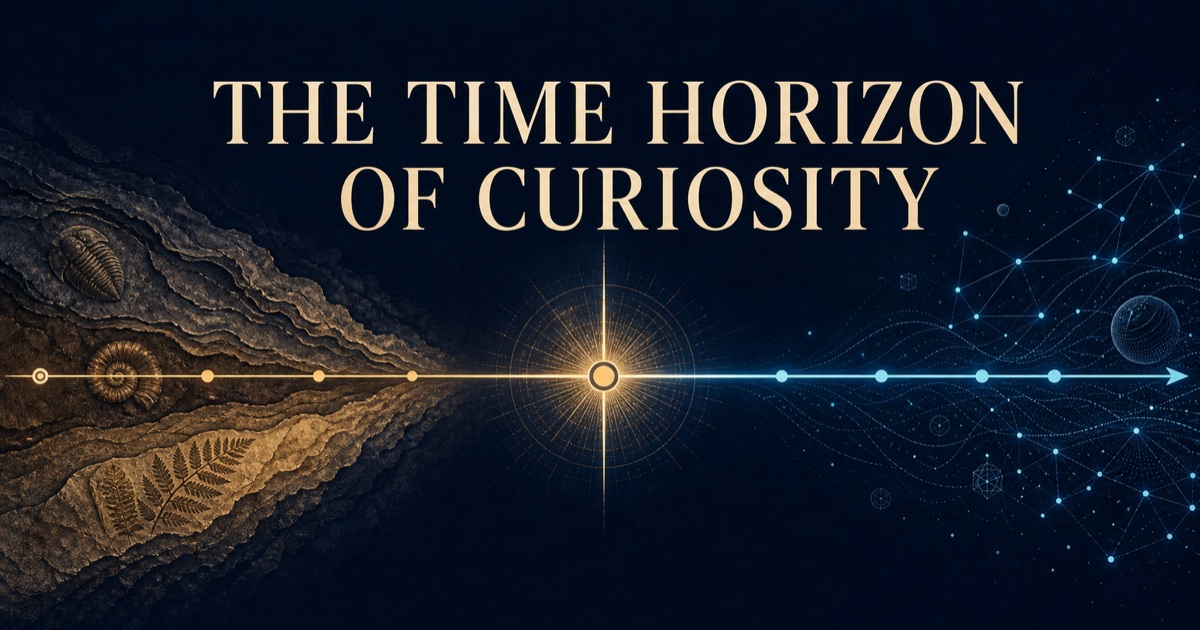
The Time Horizon of Curiosity, illustrated as a line travelling from fossils in the deep past through the present into a computational future

Some minds are magnetised by the urgent present. Others instinctively reach backwards toward origins, or forwards toward possibility. These are not rankings of intelligence. They are different time horizons through which the world becomes interesting.

Find your orientation

01

Three recurring orientations

The news cycle is only one scale of human interest.

Our information environment heavily favours the present. Social feeds compress attention into minutes and hours; politics and markets make recency feel consequential. Yet many people experience curiosity on a much longer wavelength. They want to know what preceded us, what persists beneath the headlines, and what worlds might follow.

01

The immediate present

What is happening now?

Current affairs, politics and social networks reward attention to what has just changed: the newest argument, election, crisis, trend or reaction. This orientation keeps us socially coordinated and alert to decisions that cannot wait.

Politics · News · Markets · Social media

02

The deep past

How did we get here?

History, archaeology, anthropology and geology widen the frame. Their pleasure lies in origins, long patterns and worlds unlike our own. The present becomes one thin layer in a much larger story.

History · Archaeology · Evolution · Cosmology

03

Possible futures

What might happen next?

AI, engineering, climate science and speculative thought look beyond the immediate horizon. They ask what can be built, what may emerge and which choices made now could shape lives decades or centuries away.

AI · Engineering · Foresight · Climate
“The most revealing question may not be what interests you, but how far from now your attention naturally travels.”

These orientations overlap. AI is a present-day political and economic force, a continuation of centuries of automation, and a speculation about distant futures. Archaeology uses modern chemistry and computing. Climate science reconstructs ancient atmospheres to model choices whose effects will outlive us. The richest subjects often connect all three horizons.

The disciplinary map

Subjects occupy ranges, not boxes.

The line shows a discipline's temporal reach; the symbol marks its usual centre of attention. The vertical position describes how it encounters the present—from meaning and institutions to living, designed and physical systems.

02

A small self-portrait

Notice where your attention comes alive.

Most of us can move across the whole timeline, but we rarely feel equally at home everywhere. A few questions can reveal your default distance from now.

  1. 01

    When a story breaks, do you want the latest update—or the older pattern behind it?

  2. 02

    Does uncertainty feel more inviting when it concerns a lost world or an unwritten future?

  3. 03

    Are you drawn to people and institutions, living systems, designed systems, or the physical universe?

  4. 04

    Which subjects make the present feel larger rather than merely louder?